Sold out
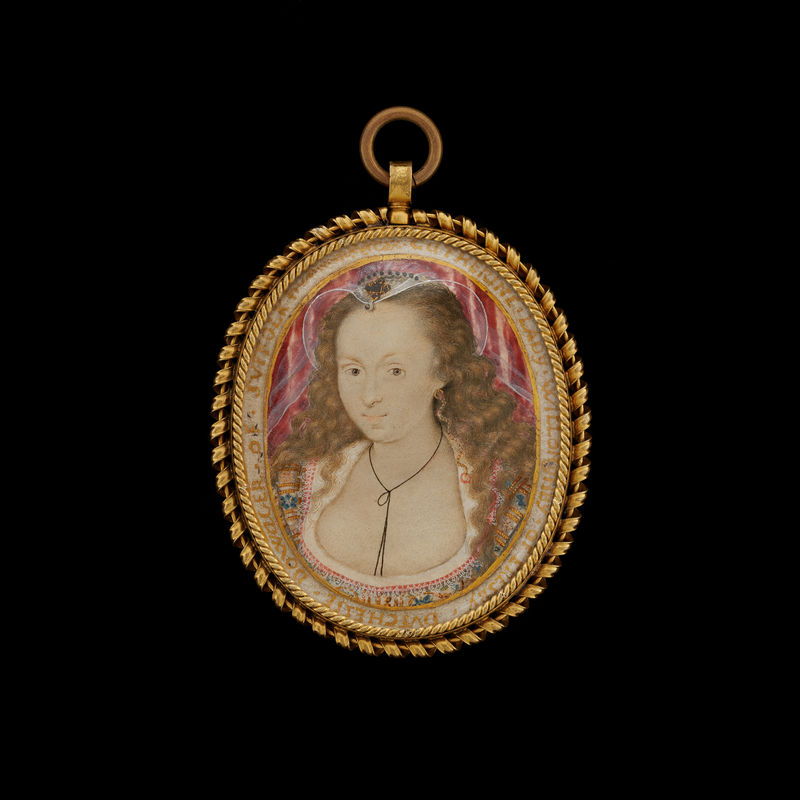
This striking miniature by Isaac Oliver presents an unidentified young woman in deliberately androgynous dress, combining masculine and feminine elements to create an image that is both fashionable and provocative. Her broad-brimmed black hat, pointed doublet, jewelled aigrette, and vivid orange sash draw on conventions more commonly associated with male portraiture, while her loose hair and pearls retain associations of femininity, youth, and desirability. The result is a carefully constructed performance of identity that reflects the fluid culture of masque, court entertainment, and elite display in the final years of Elizabeth I’s reign and the early Jacobean court.
Such attire was not entirely unconventional within aristocratic circles. Noblewomen adopted masculine costume for hunting, riding, and court masques, particularly under the influence of Anne of Denmark, whose court fostered a culture of theatrical self-fashioning. Oliver’s sitter recalls the kinds of figures criticised in contemporary pamphlets railing against the ‘man-woman’, yet the portrait itself suggests confidence rather than satire. The sitter’s hand...
This striking miniature by Isaac Oliver presents an unidentified young woman in deliberately androgynous dress, combining masculine and feminine elements to create an image that is both fashionable and provocative. Her broad-brimmed black hat, pointed doublet, jewelled aigrette, and vivid orange sash draw on conventions more commonly associated with male portraiture, while her loose hair and pearls retain associations of femininity, youth, and desirability. The result is a carefully constructed performance of identity that reflects the fluid culture of masque, court entertainment, and elite display in the final years of Elizabeth I’s reign and the early Jacobean court.
Such attire was not entirely unconventional within aristocratic circles. Noblewomen adopted masculine costume for hunting, riding, and court masques, particularly under the influence of Anne of Denmark, whose court fostered a culture of theatrical self-fashioning. Oliver’s sitter recalls the kinds of figures criticised in contemporary pamphlets railing against the ‘man-woman’, yet the portrait itself suggests confidence rather than satire. The sitter’s hand gently cradling her lovelock introduces an overtly romantic dimension, implying that the miniature may have been conceived as a love token intended for private exchange.
Oliver’s extraordinary technical skill is evident here. The miniature survives in remarkable condition, its brilliant oranges remaining exceptionally vivid against the deep blue background and black costume. Particularly striking is the subtle movement of the suspended pearls, tilted slightly as though the sitter has only just turned towards the viewer. Such details create a sense of immediacy unusual in portrait miniatures, transforming this small work into a remarkably vivid study of performance, identity, and self-fashioning at the early Stuart court.