


Enquire
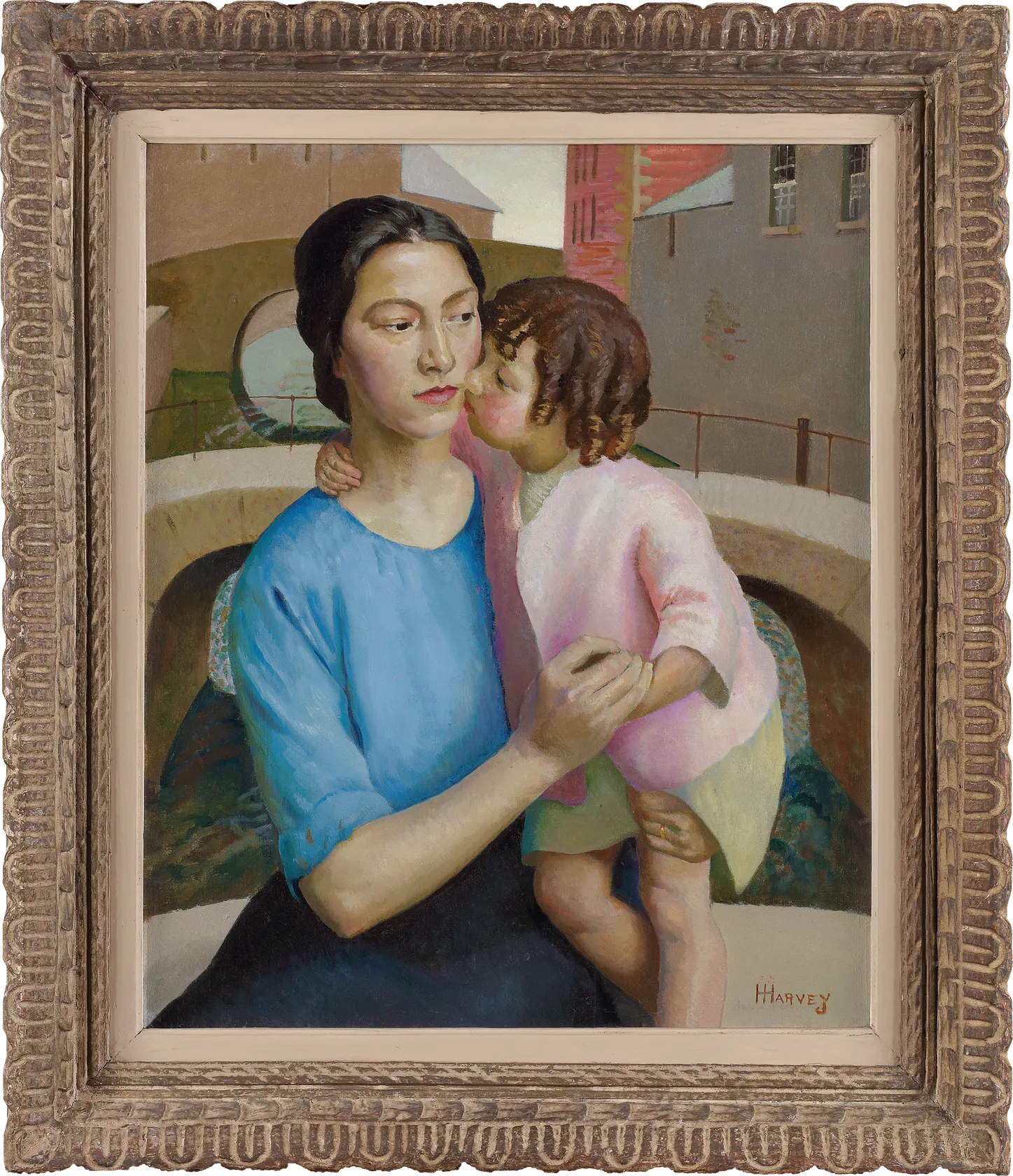
One of the leading figures of the Newlyn School and a lifelong painter of Cornwall, Harold Harvey brought to his work a deep familiarity with both place and people. In Madonna of the Bridges, he draws on contemporary models to reinterpret an enduring Renaissance archetype, recasting the Madonna and Child within the sensibilities of modern life.
At first glance, the setting of Madonna of the Bridges might be mistaken for the canals of Venice. In fact, Harvey situates his composition in Newlyn Coombe, Cornwall, a landscape he knew intimately, having spent almost his entire life in West Cornwall. Described by Caroline Fox and Francis Greenacre as ‘the only artist from two generations of Newlyn painters who could truly be called a ‘son of Cornwall’,’ Harvey brought to his work a deep familiarity with the rhythms and textures of local life. Here, the bridges of Newlyn are transformed into a setting of quiet monumentality, their arching forms framing the central figures...
One of the leading figures of the Newlyn School and a lifelong painter of Cornwall, Harold Harvey brought to his work a deep familiarity with both place and people. In Madonna of the Bridges, he draws on contemporary models to reinterpret an enduring Renaissance archetype, recasting the Madonna and Child within the sensibilities of modern life.
At first glance, the setting of Madonna of the Bridges might be mistaken for the canals of Venice. In fact, Harvey situates his composition in Newlyn Coombe, Cornwall, a landscape he knew intimately, having spent almost his entire life in West Cornwall. Described by Caroline Fox and Francis Greenacre as ‘the only artist from two generations of Newlyn painters who could truly be called a ‘son of Cornwall’,’ Harvey brought to his work a deep familiarity with the rhythms and textures of local life. Here, the bridges of Newlyn are transformed into a setting of quiet monumentality, their arching forms framing the central figures with a structural gravity that is both physical and symbolic.
Painted in 1930, four years after Harvey’s conversion to Catholicism, the work marks a significant moment in the artist’s spiritual and artistic development. Madonna of the Bridges belongs to a group of works in which Harvey reimagined religious scenes, usually set against recognisable local backgrounds. In another depiction of Mary, Joseph and Jesus in The Flight, the wild Cornish moor sets the backdrop of the biblical scene [fig. 1].
This power of Madonna of the Bridges lies in the subtle fusion of the sacred and the everyday. Rather than relying on overt drama or spectacle, Harvey allows meaning to emerge gradually through careful structure and subtle symbolism. With a quiet nod to Marian iconography, the mother’s blue blouse is rendered as ordinary clothing and the child’s gesture, pressing close in an intimate embrace, recalls the tenderness of the Eleousa
type Madonna and Child [fig. 2]. Harvey avoids overt theatricality, and the effect is one of quiet, controlled symbolism. The enclosing stone arches behind the figures assume an almost halo-like presence, their curvature gently framing the mother and child and anchoring them within the physical world.