

Enquire
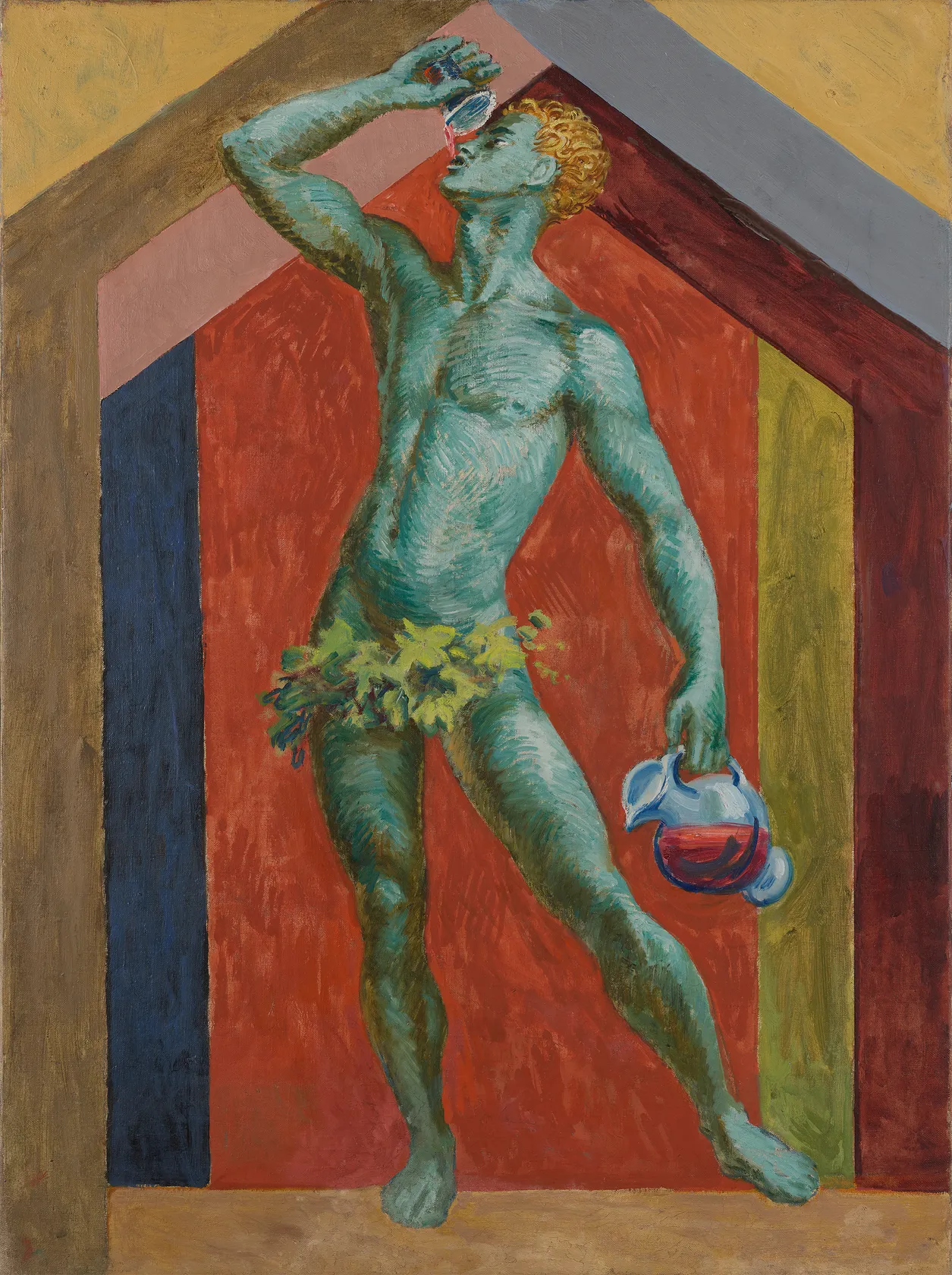
This striking composition was produced as a design for a pub sign around 1940-1942. The work formed part of a scheme managed by Elizabeth Winifred Martin, the wife of Kenneth Clark, who was invited to edit a King Penguin volume devoted to English pub signs. The project paired contemporary artists with historic public houses, inviting them to design new signs. Among those commissioned were several leading modern British painters, including Duncan Grant, Graham Sutherland, Paul Nash and John Piper. This work by Grant was designed for ‘The Green Man’, a subject long embedded in the visual folklore of British pub signage.
The identity of the figure in Grant’s design has been suggested to be Paul Roche; however, this is unlikely to be the case. Grant did not meet Roche until 1947, several years after the present work was likely executed. The association is nevertheless understandable. Roche would later become one of Grant’s most frequently depicted sitters, appearing repeatedly across paintings...
This striking composition was produced as a design for a pub sign around 1940-1942. The work formed part of a scheme managed by Elizabeth Winifred Martin, the wife of Kenneth Clark, who was invited to edit a King Penguin volume devoted to English pub signs. The project paired contemporary artists with historic public houses, inviting them to design new signs. Among those commissioned were several leading modern British painters, including Duncan Grant, Graham Sutherland, Paul Nash and John Piper. This work by Grant was designed for ‘The Green Man’, a subject long embedded in the visual folklore of British pub signage.
The identity of the figure in Grant’s design has been suggested to be Paul Roche; however, this is unlikely to be the case. Grant did not meet Roche until 1947, several years after the present work was likely executed. The association is nevertheless understandable. Roche would later become one of Grant’s most frequently depicted sitters, appearing repeatedly across paintings and drawings in a variety of guises.
The two men first met in 1946 outside Piccadilly Circus tube station and remained close friends for the next thirty-two years until Grant’s death in 1978. Roche, who was thirty at the time, started modelling for Grant the day after their chance encounter. He later recalled the experience with candour, observing that “Though it was the summer, two things I realised as a model: you soon get tired of even the very easy pose… [and] it seems warm but you begin to feel cold.”[1] Roche’s striking presence and theatrical bearing appealed strongly to Grant, who depicted him in numerous roles and guises. Over time, he became not only a regular model but Grant’s closest companion during the final phase of the painter’s life.
The patterned background relates to an abstract fire screen, decorated with a central goldfish motif, that remains today in the collection at Charleston, East Sussex. Grant frequently returned to visual ideas developed during the Omega Workshops period, incorporating motifs or designs from earlier decorative projects into later paintings, though few examples are quite so bold as this. This deliberate self-reference recalls the spirit of Omega, where the boundaries between fine and applied art were deliberately blurred.
[1] Paul Roche quoted in P. E.H. Davis ‘Painter’s Model and Poet: Paul Roche’, Canvas Issue 23 [Accessed at: https://www.charleston.org.uk/painters-model-and-poet-paul-roche/]