Sold out
1 of 2


Isaac Oliver
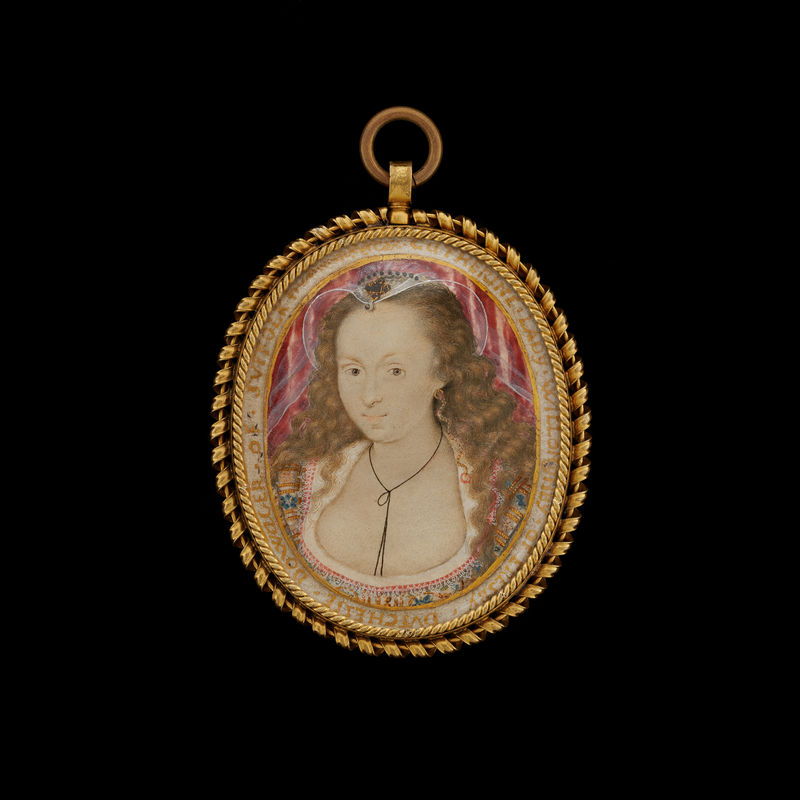
(c. 1565-1617) An unidentified lady in masquing attire, formerly called Alice, née Spencer, Countess of Derbyc.1600-10
Watercolour on vellum laid onto a playing card In a later turned wood frame with two hearts verso
57 mm high (oval)
Provenance
By 1938, Walter Samuel (1882-1948), 2nd Viscount Bearsted;
Thence by descent in the Smauel family;
Philip Mould & Company, acquired from the above, 2024;
Private collection, U.K.
Literature
The Royal Academy of Arts, (1938) Exhibition of Seventeenth Century Art in Europe [Exhibition Catalogue]. London: The Royal Academy of Arts, p. 223 (no. 760);
Graham Reynolds, (1947) Nicholas Hilliard and Isaac Oliver: An Exhibition to Commemorate the 400th Anniversary of the Birth of Nicholas Hilliard [Exhibition Catalogue]. London: Victoria & Albert Museum, p. 43 (cat. 172);
Sydney D. Cleveland and David Piper, (1953) Sixteenth-Century Portraits of Famous Early Elizabethans [Exhibition Catalogue]. Manchester: Manchester City Art Gallery, p. 9 (cat. 5);
The Royal Academy of Arts, (1956/7) British Portraits, Winter Exhibition [Exhibition Catalogue]. London: The Royal Academy of Arts, p. 193 (no. 631);
Graham Reynolds, (1971) Nicholas Hilliard & Isaac Oliver. London: H.M. Stationary Office, (no. 172);
Roy Strong and Vernon J. Murrell, (1983) Artists of the Tudor Court: The Portrait Miniature Rediscovered, 1520-1620 [Exhibition Catalogue]. 2nd edn. London: Victoria & Albert Museum, p. 111 (no. 168);
Graham Reynolds, (1988) English Portrait Miniatures. Rev. edn. Cambridge: Cambridge University Press, p. 27 (fig.13);
Jill Finsten, (1981) Isaac Oliver: Art at the Courts of Elizabeth I and James I. Ph.D. thesis, Harvard University, 1979. New York: Garland [Outstanding Dissertations in the Fine Arts], vol. 2, pp. 97-98 (no. 62);
Philip Mould & Company, (2019) Jewel in the Hand: Early Portrait Miniatures from Noble & Private Collections [Exhibition Catalogue]. London: Philip Mould & Company, pp. 86-87 (no. 24).
Exhibitions
Burlington House/The Royal Academy of Arts, London, ‘Exhibition of Seventeenth Century Art in Europe’, 3 January – 12 March 1938, no. 760;
Victoria and Albert Museum, London, ‘Nicholas Hilliard and Isaac Oliver: An Exhibition to Commemorate the 400th Anniversary of the Birth of Nicholas Hilliard’, 31 May – 31 August 1947, no. 172;
Manchester City Art Gallery, ‘Sixteenth-Century Portraits of Famous Early Elizabethans’, 12 May – 21 June 1953, no. 5;
Royal Academy of Arts, London, ‘British Portraits: Winter Exhibition’, 1956/7, no. 631;
Victoria and Albert Museum, London, ‘Artists of the Tudor Court: The Portrait Miniature Rediscovered, 1520-1620’, 9 July – 6 November 1983, no. 168;
Philip Mould & Company, London ‘Jewel in the Hand: Early Portrait Miniatures from Noble & Private Collections’, 12 March – 18 April 2019, no. 24;
Philip Mould & Company, London, ‘Miniatures from the Bearsted Collection’, 19 November – 19 December 2025.
Sold
This remarkable miniature by Isaac Oliver depicts an unidentified woman in masquing attire, capturing the highly theatrical culture of the early Jacobean court. Shown in elegant profile against a deep blue ground, the sitter wears loose flowing hair, a flame-coloured drapery, and a revealing costume that exposes the breast – an appearance closely associated with the allegorical and often highly sensual world of court masque. Such entertainments combined music, dance, poetry, and elaborate costume to create spectacles in which elite women could temporarily assume mythological or symbolic identities.
Oliver’s use of the profile format is significant. Derived from antique coins and medals, profile portraiture carried associations of authority, learning, and classical refinement. Oliver appears to have reserved it for particularly elevated or culturally sophisticated sitters, including Anne of Denmark and Prince Henry. Although the identity of the present sitter remains unknown, the miniature suggests a woman deeply connected to the artistic and performative culture surrounding the Stuart court.
The image...
This remarkable miniature by Isaac Oliver depicts an unidentified woman in masquing attire, capturing the highly theatrical culture of the early Jacobean court. Shown in elegant profile against a deep blue ground, the sitter wears loose flowing hair, a flame-coloured drapery, and a revealing costume that exposes the breast – an appearance closely associated with the allegorical and often highly sensual world of court masque. Such entertainments combined music, dance, poetry, and elaborate costume to create spectacles in which elite women could temporarily assume mythological or symbolic identities.
Oliver’s use of the profile format is significant. Derived from antique coins and medals, profile portraiture carried associations of authority, learning, and classical refinement. Oliver appears to have reserved it for particularly elevated or culturally sophisticated sitters, including Anne of Denmark and Prince Henry. Although the identity of the present sitter remains unknown, the miniature suggests a woman deeply connected to the artistic and performative culture surrounding the Stuart court.
The image resonates strongly with descriptions of contemporary masques. Ben Jonson’s Masque of Beauty (1608), for example, describes a character named ‘Splendor’ entering ‘naked breasted’ with ‘bright hair loose flowing’, while eyewitness accounts of aristocratic entertainments similarly describe female masquers with uncovered hair and vividly coloured drapery. Yet the miniature also contains a more intimate and enigmatic detail. Suspended from the sitter’s pearl earring is a lock of hair, traditionally associated with remembrance or mourning. Its inclusion introduces an unexpected note of emotional complexity into an otherwise celebratory image, hinting at personal meanings now lost. Oliver’s extraordinary delicacy of handling – visible in the translucent flesh tones, flowing hair, and luminous costume – heightens the sense of immediacy.